
Privacy notes for Stake Casino Australia readers
What data may be logged during review workflows and how to keep stronger account hygiene, safer device habits, and cleaner identity records for compliance.
- 🧷 Use unique credentials and 2FA
- 📂 Record each document submission event
- 🧼 Review stale sessions and recovery settings monthly
📌 What data points are usually collected
🔍 Operational data reality
Most players think privacy starts at policy pages, but in practice it starts in workflows. Systems may log account actions, device patterns, IP ranges, payment metadata, and support transcripts. None of this is abstract when your payout enters review. The point is not paranoia - it is traceability awareness.
I treat every sensitive interaction as if it could be referenced later in a compliance check. That means cleaner inputs, fewer unnecessary details in chat, and disciplined handling of identity files. Good privacy practice improves both safety and resolution speed.
✅ Why this matters during disputes
When records are clean and minimal, support can verify faster and with fewer loops. Oversharing and inconsistent details create avoidable confusion that often extends pending windows.
📌 Account hygiene for AU players
🔍 Daily habits that reduce risk
Use one dedicated password manager entry, unique password, and no account sharing. Keep payment route ownership aligned with profile details. These are boring habits, but they prevent the most common account frictions. I also recommend checking login alerts and recent device activity weekly.
If you switch networks often, be extra careful with session persistence and password reuse. Small shortcuts in routine security create big headaches when verification strictness increases around withdrawals.
✅ Practical monthly checklist
Rotate critical credentials, close stale sessions, test recovery path, and confirm notification channels still work. This takes minutes and prevents long support escalations later.
📌 Document handling and retention discipline
🔍 Send less, send clearer
When identity docs are requested, send exactly what is asked - nothing more. Keep filenames clear, images readable, and submission timestamps recorded. If asked again, reference prior submission with date and case ID instead of re-uploading random variants.
I keep a simple log: what was sent, to which channel, and for what request. That log turns memory-based arguments into evidence-based communication.
✅ Safer support interaction pattern
Never drop sensitive details into multiple chat windows. One controlled thread with precise attachments is safer and easier to audit. Privacy is easier when communication is structured.
📌 Privacy checks before high-value withdrawals
🔍 Pre-withdraw privacy preflight
Before larger requests, verify credential freshness, document status, and method ownership match. Remove unnecessary active sessions and avoid public network submissions. This lowers both fraud flags and support ambiguity.
I also review whether previous support messages contain conflicting identity details. Fixing inconsistency before withdrawal requests prevents unnecessary hold cycles.
✅ Final privacy note
Privacy recap: minimize exposure, preserve evidence quality, and keep channel boundaries clean. This approach protects account stability over the long run.

🗂️ Extended privacy operations notes
Identity data minimization in practice
Privacy risk drops sharply when identity sharing is intentional rather than reactive. I submit only the required document set for the specific request and log the exact channel, timestamp, and case reference. Oversharing does not create trust; it creates noise and future exposure. Minimal, precise submissions are safer and easier to audit later.
I also avoid embedding sensitive identifiers in broad chat messages. Attachments should carry detail; chat text should carry structure. This separation limits accidental leakage and keeps records clean for compliance teams.
Device hygiene and session control
Most privacy incidents are not dramatic hacks; they are routine hygiene failures: reused passwords, stale sessions, and weak recovery settings. A monthly hygiene cycle is enough for most players: rotate critical credentials, review active sessions, and confirm recovery contacts. These habits reduce both fraud risk and account lock friction.
If you use multiple devices, label trusted devices and remove old entries aggressively. Forgotten device trust states are a common source of confusion during security checks.
Network behavior and risk posture
Public networks increase uncertainty around account integrity signals. I avoid sensitive account actions - document uploads, payout changes, credential resets - on unmanaged networks. If unavoidable, I delay final submission until I can verify session integrity from a trusted connection.
Network discipline may seem unrelated to gaming flow, but it materially affects downstream verification confidence. Cleaner signals produce faster reviews.
Support communication and privacy boundaries
Support threads should contain only what is needed to resolve the issue. I do not paste full identity details in repeated messages. Instead, I reference prior verified submissions by case ID and date. This reduces redundancy and lowers exposure footprint across archived threads.
When asked for additional proof, I request precise requirements first. Ambiguous requests often cause unnecessary data spread.
Document lifecycle management
Every submitted document should have a retention decision. Keep a secure local record of what was sent and when, but avoid uncontrolled copies across devices. Organized retention helps during disputes and limits accidental disclosure in unrelated contexts.
I also review whether old documents are still relevant before resubmitting. Sending outdated files repeatedly can trigger avoidable review loops.
Operational privacy before withdrawals
Before larger payouts, I run a privacy preflight: credential freshness, device list sanity, method ownership consistency, and current verification state. This is not paranoia; it is workflow smoothing. Privacy integrity and payout reliability are tightly connected in real operations.
If any part is unclear, I resolve it before requesting withdrawal. Prevention is faster than escalation.
Behavioral privacy under stress
Privacy mistakes spike when players are frustrated. Under stress, people overshare in chat, send duplicate files, and lose thread discipline. I use a simple rule: pause first, then submit one clean packet. This keeps the case coherent and limits exposure.
Calm structure is a privacy control. Emotional urgency is understandable, but it should not shape data handling decisions.
Final privacy doctrine
Strong privacy is cumulative routine, not a single setting toggle. Minimal sharing, clean logs, controlled channels, and regular hygiene create compounding protection over time. These habits also improve support outcomes by keeping records consistent and easy to verify.
Use this section as a weekly checklist template. The players who maintain low-noise privacy routines usually face fewer escalations and shorter resolution cycles.
Brand chart for this page
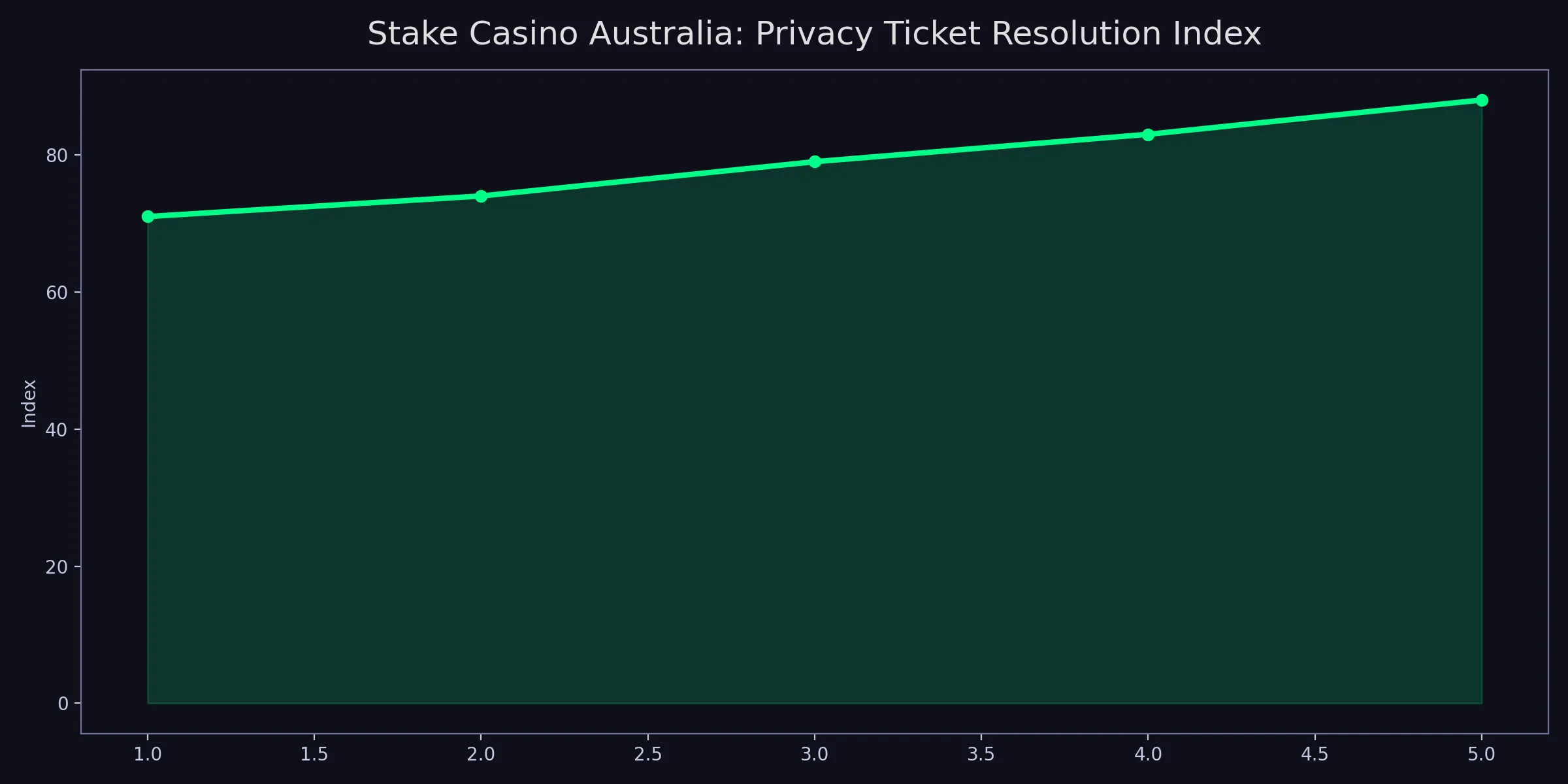
This privacy chart is best read as a behavior mirror. Improvements usually follow routine hygiene upgrades: cleaner credential management, tighter session control, and lower data scatter across support channels. It is not a badge of guaranteed safety; it is feedback on process quality over time.
Readers can replicate the benefit by tracking three simple markers each month: credential updates completed, stale sessions removed, and document submissions logged. Small consistency beats occasional heroic cleanup. Privacy resilience is mostly routine engineering.
When incidents occur, chart context helps decide whether the fix belongs to account hygiene, communication discipline, or escalation workflow. That triage saves time and reduces repeat exposure.
This chart reinforces the same rule as the main page: privacy outcomes improve when routines are explicit and repeatable. I treat each movement as a reflection of behavioral hygiene rather than as proof of absolute security. A short-term improvement can happen by chance, but sustained improvement usually appears only when credential policy, session control, and document handling are consistently maintained. That is why this section emphasizes process quality over one-off fixes.
In practice, I map incidents to root categories: credential weakness, session sprawl, submission noise, or channel leakage. Category mapping helps avoid generic responses like "be more careful." Instead, each category receives a concrete corrective action: password rotation cadence, stale session cleanup, structured submission logging, or tighter support-channel boundaries. This translation from incident to action is what converts chart reading into operational improvement.
I also use this chart to monitor privacy debt accumulation. Privacy debt grows when shortcuts stack: reused credentials, untracked uploads, and fragmented ticket threads. Each shortcut feels minor in isolation but creates compounding exposure over time. By visualizing trend direction, I can detect when debt is building before it becomes a high-friction event during payout verification.
Another important interpretation layer is context sensitivity. Incident rates can change with device switching, travel networks, or intense bonus periods that increase document and support interactions. So I annotate chart windows with context tags. This prevents false attributions and makes remediation more precise. Without context tags, people often fix the wrong thing and repeat the same failure pattern later.
For readers, a useful template is monthly privacy review in four steps: verify credential freshness, prune active sessions, audit recent support submissions, and reconcile document logs against case references. This takes little time and dramatically improves both account resilience and dispute readiness. The value is not only fewer incidents, but also faster and cleaner recovery when incidents happen.
Finally, remember that privacy is a stability function. Better privacy habits reduce uncertainty during high-value workflows, which lowers decision stress and improves communication quality. In that sense, privacy discipline supports the entire operational stack - security, support, and payout confidence alike.
🛡️ Long-form privacy resilience appendix
This appendix treats privacy as an operational system rather than a legal checkbox. A resilient system combines credential policy, session governance, data minimization, and communication hygiene. Weakness in any one layer can compromise the others. For example, excellent password policy loses value if support threads scatter identity data across multiple channels. Privacy resilience is therefore a stack problem.
The first layer is identity discipline. I recommend limiting identity exposure to exact-request scope and preserving submission logs with timestamps and case references. This protects both security and dispute readiness. During high-friction events, clean submission history can shorten verification loops dramatically.
The second layer is session governance. Active session sprawl is a common but overlooked risk. Periodic pruning of old device sessions reduces attack surface and prevents confusing account-state signals during reviews. I include this task in monthly hygiene cycles so it becomes routine rather than emergency work.
The third layer is channel hygiene. Communication channels should carry only necessary data at the appropriate abstraction level. Detailed identity proof belongs in controlled attachments; conversational text should focus on chronology and requested action. This separation reduces accidental exposure and improves readability for reviewers.
The fourth layer is recovery readiness. Strong systems assume incidents will happen and optimize for clean recovery. Recovery readiness includes clear credential-reset path, verified backup contact method, and disciplined logging of prior submissions. Without these controls, small incidents can escalate into prolonged account friction.
Finally, privacy resilience is measured over time, not by one incident-free week. Track trends, review weak points, and update routines quarterly. Compounding routine quality produces the strongest long-term protection and the smoothest operational outcomes.